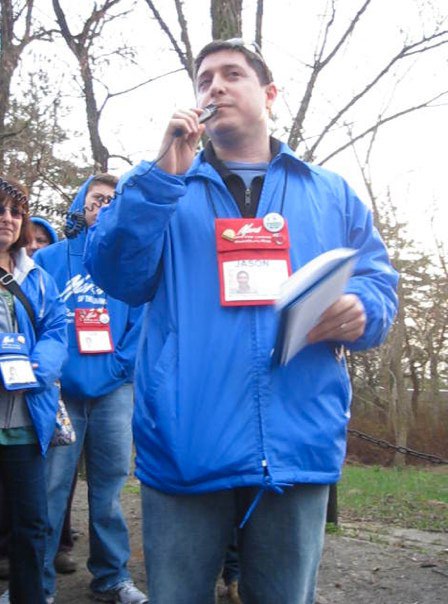
By Jason Wasser, LMFT, CAP | The Family Room Wellness Associates
Table of Contents
- What Campus Antisemitism Looks Like Up Close
- What Derek Peterson Actually Did
- The University of Michigan’s Apology Is Not Enough
- The Mental Health Reality of Campus Antisemitism
- To Every Jewish Student Who Was There
- Neutrality Is Not a Policy — It Is Complicity
Campus antisemitism is not a political talking point. It is a public health crisis — and on May 2, 2026, it was on full display at the University of Michigan’s spring commencement ceremony.
Faculty Senate Chair Derek Peterson stood before thousands of graduates and their families and chose to honor the pro-Palestinian activist movement on their campus — a movement whose members, on that very campus, vandalized a Jewish regent’s home, assaulted a Jewish student, disrupted a prior graduation, and destroyed university property.
He did not go off script. He made a calculated choice.
As a licensed marriage and family therapist, a former staff member at Princeton University’s Center for Jewish Life, and a clinician whose work includes supporting clients — among them creative artists, musicians, and comedians — navigating the psychological toll of campus antisemitism, I am done with measured responses. I am done with institutional hedging. And I am done pretending that what happened at the University of Michigan, and what continues to happen at campuses across this country, is anything other than a targeted, deliberate act of harm toward the Jewish community.
I also speak as someone with family members who are proud University of Michigan graduates. This is not an abstraction for me. This is personal.
What Campus Antisemitism Looks Like Up Close {#what-campus-antisemitism-looks-like}
Campus antisemitism does not always arrive wearing a swastika. More often, it arrives in the form of institutional normalization — a faculty leader at a podium, a university that looks the other way, a tepid apology that changes nothing.
For two years, Jewish students at the University of Michigan have endured encampments, vandalism, harassment, and the deliberate erosion of their sense of safety. The Anti-Defamation League has documented a dramatic rise in campus antisemitic incidents since October 7, 2023. The data is not ambiguous. The trend is not subtle.
What Peterson did at that commencement ceremony was not an isolated event. It was the logical endpoint of two years of institutional failure — and it happened because the University of Michigan allowed it to happen.
What Derek Peterson Actually Did {#what-derek-peterson-did}
Peterson structured his speech around pioneers in University of Michigan history — women who fought for admission, Black students who demanded representation, the school’s first Jewish professor, Moritz Levi.
Then he pivoted to praise the very movement that has made Jewish students feel unsafe on that campus for two years.
He wrapped pro-Palestinian activists in the legacy of Moritz Levi — a Jewish professor who spent his life building a refuge from antisemitism — and desecrated that legacy to score a political point.
That is not courage. That is not academic freedom. That is campus antisemitism with a faculty title.
The University of Michigan’s Apology Is Not Enough {#university-apology-not-enough}
The University of Michigan’s response — a carefully worded statement about “institutional neutrality” — does not begin to address what they allowed to happen, or what they have been allowing to happen for two years.
They had Peterson’s remarks in advance. They knew his record. They knew he authored a Faculty Senate resolution calling for divestment from Israel. They put him at that microphone anyway. They do not get to call that an accident.
To the University of Michigan: your apology is an insult. Derek Peterson should face professional consequences. And your Jewish community deserves far more than a press statement.
The Mental Health Reality of Campus Antisemitism {#mental-health-reality}
As a therapist, I need to name what is actually happening to Jewish students, parents, and community members navigating campus antisemitism right now.
I have sat with clients — students, parents, artists, performers — who no longer feel safe identifying as Jewish in public spaces. Who flinch at news alerts. Who self-censor. Who grieve not only October 7 but every day since, as they watched their institutions choose political comfort over their safety.
Trauma does not exist in isolated moments. It accumulates.
Every encampment. Every disrupted graduation. Every vandalized home. Every tepid institutional apology. It all lands. It compounds. And when a faculty leader at a flagship university stands at a commencement podium and validates the movement behind that trauma, it tells Jewish students exactly where they stand in the eyes of their institution.
For those seeking support, resources for Jewish mental health are available through the Jed Foundation and similar organizations. If you are a Jewish student, artist, or professional struggling with identity-based trauma, you are not alone — and you do not have to navigate this without support.
That is a clinical reality — not a political opinion.
To Every Jewish Student Who Was There {#to-every-jewish-student}
To every Jewish student who sat in that stadium on what should have been the proudest day of your academic life and instead felt erased — I see you. What happened to you was real. It was intentional. You deserved better.
And to my own family members who carry a Michigan degree with pride — you deserved better too. This institution owes you more than this.
Neutrality Is Not a Policy — It Is Complicity {#neutrality-is-complicity}
Every institution still hiding behind “neutrality” while campus antisemitism grows should be on notice.
Neutrality in the face of hatred is not a virtue. It is a choice. And it is the wrong one.
I will not be neutral. I will not be measured. And I will not stop saying it.
If you or someone you know is navigating the psychological impact of antisemitism, campus trauma, or identity-based harm, I provide telehealth therapy across Florida, Georgia, South Carolina, New Jersey, Missouri, and Massachusetts.
👉 Schedule a consultation at thefamilyroomsfl.com
Jason Wasser, LMFT, CAP is the founder of The Family Room Wellness Associates, a mind-body integrative private practice based in Hollywood, FL. He is a former staff member of Princeton University’s Center for Jewish Life and a Level III Certified NET Practitioner.